
Robot Game — Mission Strategy
Close to home, grouped smart.
We choose missions near home base, build attachments that do more than one job, and group missions into runs to save time in the launch area.
5
runs
450
max points
380
mission points
West → East
across the board
How we plan our runs
1 Get to know the game board.
2 Discuss which missions to attempt and which attachments they need.
3 Group missions into runs.
4 Work out the run order, sweeping from the west side of the board to the east.
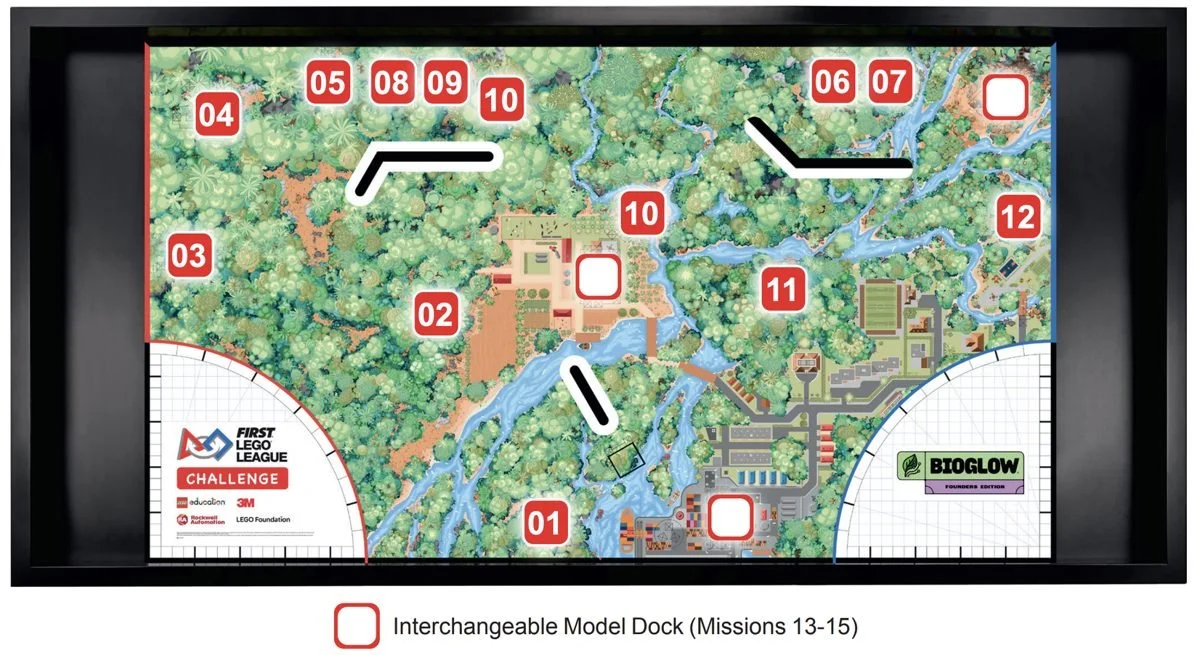
Run map. [UPDATE the legend to show all five runs]
Run table
Every run, every mission.
Run 1 · 60 pts
El Trio
Mission 8: Tangled — 30
Mission 9: Research Platform — 30
Run 2 · 30 pts
Bamboo Shoot
Mission 3: Flip the Rock — 30
A leave-behind: it stays on the field.
Run 3 · 60 pts
Miso
Mission 2: Exploding Seeds — 30
Mission 5: Reaching Roots — 20
Mission 4: Lucky Leaves — 10
Run 4 · 110 pts
Bean Sprout
Mission 1: Drone Survey — 30
Mission 15: Biocentric Architecture — 10
Mission 13: Keystone Species — 30
Mission 6: Leafcutter Frenzy — 40
Run 5 · 100 pts
Nori
Mission 11: Window to the Past — 20
Mission 7: Humongous Fungus — 30
Mission 12: Forest Elder — 20
Mission 15: Biocentric Architecture — 30
Not in a run yet
Mission 10: Fragile Microhabitats — 20
Missions — 380
+ equipment inspection — 20
+ precision tokens — 50
= 450 max points
Coding
Why we chose Python over block code.
We built our own Pybricks library with basic turns and more advanced functions such as heading correction and acceleration/deceleration.
More precise
Heading correction keeps the robot on its line.
Smoother motion
Gentler speeding up and slowing down means more repeatable runs.
Easier to annotate
Comments keep everyone on the team able to read and fix the code.
Next: meet the robots