
Innovation Project — Problem & Solution
The Enhanced Demi-Lune
A half-moon pit that catches rain, wearing a lightweight shield of natural fibre so the soil stays put until plants can hold it.
Our question
How can we enhance demi-lunes with a lightweight, temporary and environmentally friendly natural-fibre shield — made from materials such as sisal, palm or water hyacinth — to protect the soil from erosion while allowing water to infiltrate into the ground?
Why this matters
Our solution could reduce soil erosion around demi-lunes, helping more water soak into the ground so plants can grow.
By using natural fibres that are available locally, communities in arid and semi-arid regions could build demi-lunes more easily and affordably — improving soil quality and supporting land restoration.

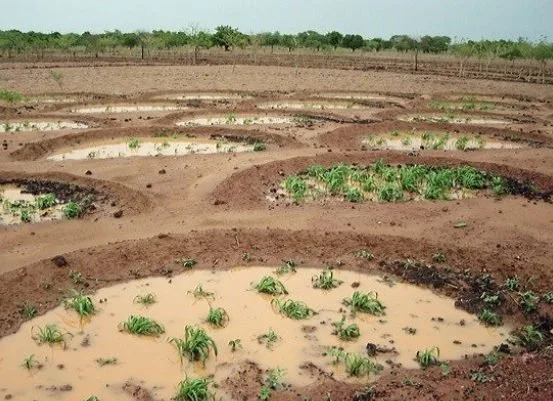
Ahh!! Our soil is washing away!
How it works
Three steps from bare soil to growing plants.
1
A demi-lune catches rain
The semi-circle pit sits on a slope so water collects and soaks in, instead of rushing off and taking soil with it.
2
A fibre geotextile shields the weak spots
Biodegradable natural-fibre designs protect the fragile parts of the pit while water still passes through.
3
Plants take over
The shield protects the soil long enough for vegetation to establish, then breaks down naturally.
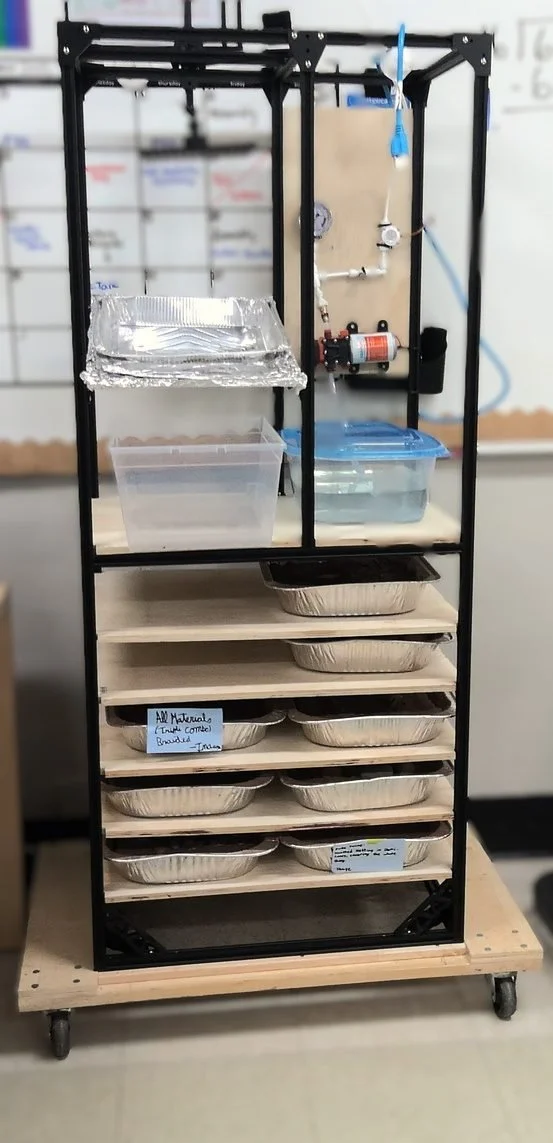
Rain nozzle
Removable trays
Wheeled frame
Our test rig
The Smart Rainfall Simulator
We built it to test how well our geotextiles hold up under different rainfall patterns, and to find which designs need strengthening.
✓ Pump and shower head — with manual and electronic pressure readers to tune the rain’s intensity.
✓ Removable collection trays on several levels catch runoff so we can compare materials.
✓ Dry-season storage — lower levels hold demi-lunes between tests so they dry out like real dry seasons.
✓ On wheels, at a comfortable height so it’s easy to move and to work at.
Testing
We didn’t stop at building. We tested a lot.
Videos show each test so judges and visitors can see the results for themselves.
Simulated rainfall on a geotextile
[VIDEO 1 — embed link]
[VIDEO 2 — e.g. field test or expert demo]
[VIDEO 2 — embed link]
Impact
Who could use it, and what it costs.
Who it helps
Farmers and land-restoration groups in arid and semi-arid regions, where stones are scarce and heavy rain can wash demi-lunes away.
What it costs
$10USD per demi-lune
How we’d share it
Sharing with our experts
Next: how the idea evolved